

The Many Faces of Masculinity: Exploring Men’s Identity in the Therapy Room

What Happens When Men Pause?
This month is Movember, when moustaches make their annual comeback. Not just as a fashion statement, but as a reminder to talk about men’s mental health, suicide prevention and physical wellbeing. It’s a time when conversations that are often tucked away behind humour or silence start to surface. Beneath the playful competition of growing a ‘tache lies something serious: the invitation for men to drop the armour, check in with themselves, and connect with others in a way that might just save a life.
I work with many men in my practice and I have learned a lot about how you guys tick….
What happens when men are given space not to perform, but to pause?
Masculinity often arrives wearing a mask, but is desperate to express itself as what it feels it is.
When men come into therapy, they often carry two kinds of weight. One is the story of their life so far, the other is the quiet, but unrelenting pressure of what the world expects a man to be. Over time, I have come to see that exploring masculinity is rarely a side topic. It is often the starting point for understanding how a man relates to himself, to others and to life as a whole. The stuckness deeply felt by many men, is also peppered with the expectation that they need to unstick - but how when they have not necessarily been role-modelled the skills to do so?
Whether it is a man in midlife re-examining his purpose, trying to get his head around living with ADHD or someone who is gender-fluid or gender-curious and exploring identity, the question beneath the surface is often the same: Who am I, and who am I allowed to be?
Masculinity as Part of Identity
I don’t view masculinity as a problem to be solved, but as an important elephant in the room to explore, and one that quietly shapes how men experience safety, love and belonging. We often talk about masculinity as if it’s a fixed quality, but in reality, it’s a living ecosystem built from family patterns, cultural scripts and invisible survival strategies. It isn’t just about how men act, it’s about how they learned to stay acceptable in the eyes of others.
Boys grow up absorbing subtle cues long before they can name them and a father’s silence can teach more about emotional boundaries than any words could. A teacher’s raised eyebrow at their tears might cement the belief that softness equals weakness. Even well-meaning phrases like “you’ll be fine” or “be strong” can quietly train a body to tighten rather than reach for comfort.
By the time many men arrive in therapy, these lessons are so deeply embodied that emotion itself can feel like foreign territory. Their nervous systems have learned to prioritise control over connection and when the armour becomes identity, even warmth can sting when they’ve lived in the cold.
For some men, their inner world has become unfamiliar territory; a place avoided or mistrusted. They may be fluent in problem-solving yet struggle to name their own needs. They can be pillars of reliability to others while quietly starving for understanding themselves. Exploring masculinity in therapy often means widening those parameters, creating permission to inhabit the full range of being human and not just the parts that seem acceptable, but also the ones that long to thrive and be heard.
Listening Beneath the Armour
In sessions, I often use Internal Family Systems (IFS) to help men get to know the different aspects of self within them. When we separate a man from his protective aspects such as the achiever, the joker, the critic or the stoic, we start to hear the quieter voices underneath. These are often younger, more sensitive aspects that have been silenced by generational beliefs about manhood.
A client might insist that he is not emotional, yet moments later describe a deep loneliness that he has never named before and with this may come emotion. I often hear “I’ve never told anyone this before”. IFS helps him recognise these internal experiences without shame, offering structure and logic to something that can otherwise feel confusing, all-consuming or unsafe.
The Nervous System as a Guide
Masculinity is lived through the body, yet many men are disconnected from physical awareness. They can identify tension but not calm and stress but not safety. This is where somatic work becomes central. Through slowing down, grounding, or simply noticing the breath, men begin to inhabit their bodies again.
This work is not about relaxation. It is about helping the body feel safe enough to speak. I often notice that when a man talks about his father, his chest may tighten. When he describes work pressure, his stomach might clench. When he mentions family responsibility, exhaustion suddenly floods through him. These sensations are not random. They are messages from the body, shaped by the vagus nerve which connects body and mind.
When we help the vagus nerve settle through breathing, grounding or simply awareness, the nervous system begins to move out of survival mode. The body starts to trust that it can feel without becoming overwhelmed and that moving back into more manageable body sensations, can help alleviate a freeze state.
For men with ADHD, this body awareness can be life-changing. Restlessness, frustration and self-criticism often show up physically as a racing pulse, clenched jaw or a constant sense of needing to move. When these signals are met with curiosity instead of control, the body and mind begin to cooperate rather than compete.
Composting the Old Stories
In my biodynamic work, we might ask what can be composted: which stories, habits, or postures have served their time? The word compost might sound simple, but in practice it asks for something profound. It means being willing to look at what is no longer nourishing and to let it break down naturally, instead of trying to tidy it away. This is often where the real magic happens.
Many men discover that the same traits that once protected them; control, self-reliance and emotional distance, now weigh them down. What once kept them safe has become armour that no longer fits. These layers are not thrown off in one moment; they soften slowly as trust grows. Think of crabs or lobsters, as they step out of their old shells and into a new one, initially soft, revealing vulnerability and allowing them to grow.
Sometimes the first sign of change is not a breakthrough, but a sigh, a tear, or a loosening in the shoulders when the body finally realises it doesn’t have to hold everything anymore.
Composting in therapy, is not about getting rid of parts of the self, but transforming them. Just as organic matter becomes fertile soil, the aspects of ourselves that feel heavy or outdated can be integrated into new understanding. Old defences can feed new awareness.
Like rose beds being turned over after a long winter, the process can be messy but it’s vital. There are moments of discomfort, even grief, as the old structures crumble. Yet something richer and more grounded begins to take shape. From what was once rigid or defensive, a different kind of strength emerges and one rooted in flexibility, compassion and quiet confidence.
Reclaiming Fluidity: Supporting Gender-Fluid and Gender-Curious Men
Working with gender-fluid and gender-curious men brings the conversation about masculinity into sharper focus. Here, identity is not assumed; it is explored, shaped and lived in deeply personal ways. Therapy becomes a space where identity can evolve safely, free from cultural expectations about how a man should think, feel, or behave.
For some, this exploration brings a sense of relief and pride and for others, it stirs up confusion, grief or a tiredness from existing between social definitions. My role as a therapist, is not to label or direct, but to walk beside them while they find language, comfort and confidence in who they are.
Masculinity and femininity are not fixed points on a map. They are fluid expressions that can coexist, shift,and grow over time and I often find that visualisations work wonders in meeting that part of self, which may be trapped. The one holding fear and shame for who they are.
Masculinity in the Therapy Room
I grew up surrounded by strong and kind men, the type who were funny, playful and brought home the bacon, but it was also a culture where strength was, too often, paired with silence. Feelings not shared and perceived weaknesses not aired. Working with men, has invited me to reflect on how those early models shaped my understanding of both resilience and vulnerability and it’s not just men who role-model silence, it’s women too.
As a woman and therapist, I am often both a witness and gentle challenger to the stories men carry. Over the years, I have come to see masculinity less as a single trait and more as a capacity: the ability to experience a full range of feelings without fear of reprisal. I believe that when men feel safe enough to soften, they do not lose their strength; they deepen it.
Approaches That Resonate
I have found that men tend to respond best to therapy that is collaborative, structured and purposeful, but still grounded in empathy. They value a sense of direction and progress rather than open-ended conversation.
IFS works particularly well, because it combines structure and compassion. Men often appreciate being able to map their inner world and understand how different aspects of self interact, as well as being held in the moment when insights arrive. Somatic work complements this, by helping them move from understanding emotions intellectually, to integrating them physically and, as I mentioned, visualisations can help explore what is going on within specific aspects of themselves, in order to understand their landscape better.
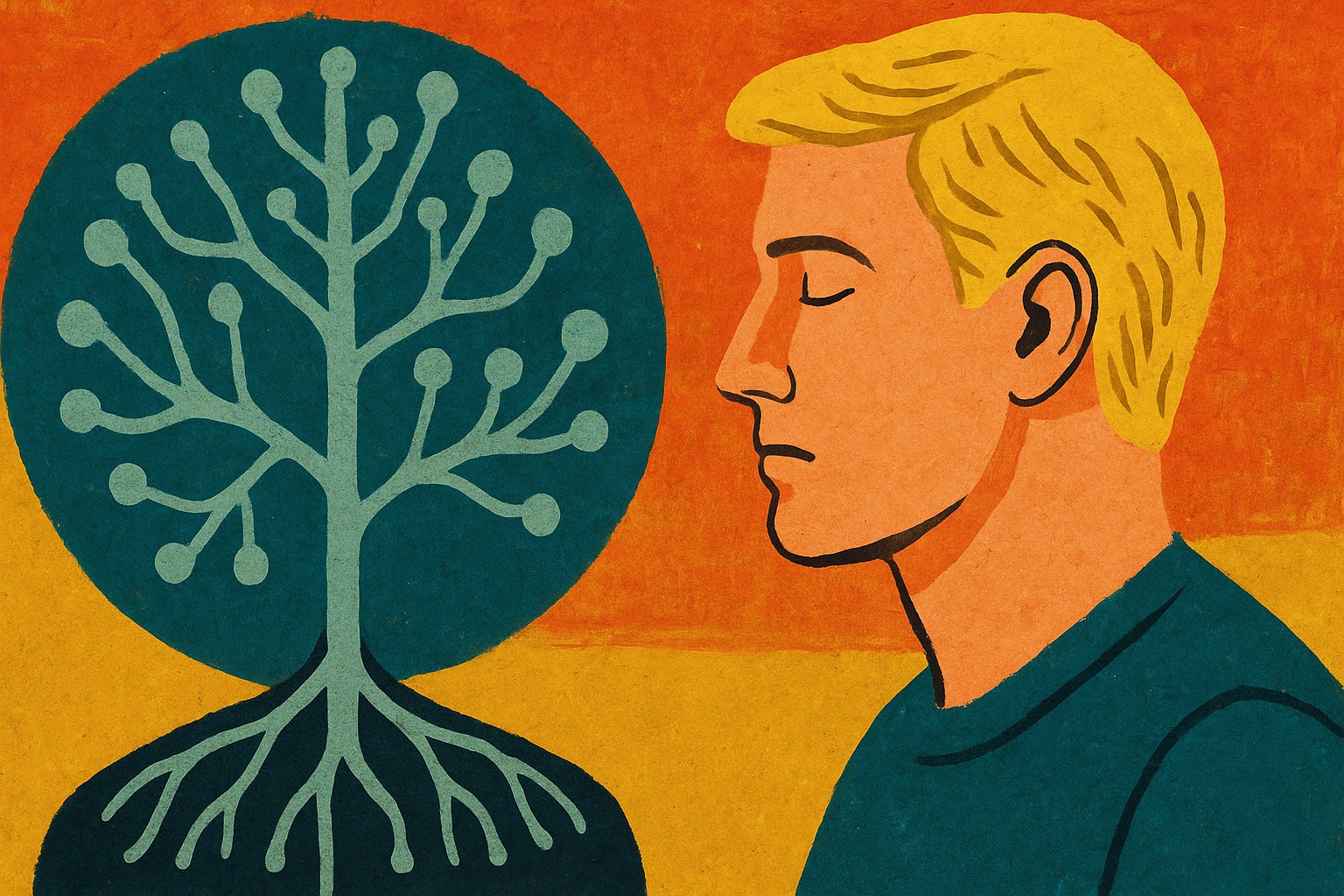
I often use nature metaphors in therapy. A tree grounded through changing weather, or a river adapting its course around rocks. This allows emotional truth to surface in a relatable way. Nature gives men a language for strength, adaptability and endurance that feels authentic and accessible, whilst providing a backdrop for moving forward with their issues.
The Body, the Brain, and the Whole Person
Research shows that male and female brains can process emotion differently. Men may take longer to identify or verbalise feelings, while women tend to integrate emotion and language more easily. In therapy, this difference needs to be respected. However both males and females are all unique humans, capable of thinking, feeling, sensing and reflecting.
When we work with the whole person, we can honour whatever emerges in the moment. Sometimes it is thought or emotion, sometimes sensation, sometimes silence. The goal is not to push emotion, but to create enough safety for emotion to reveal itself and reveal itself it does.
Cultural Narratives and Our Role as Therapists
It is important to recognise how therapy itself can sometimes feel uninviting to men. When it is presented as purely emotional or overly verbal, it can seem at odds with how many men have learned to process experience.
Therapy can instead be understood as a form of self-leadership, a space to develop awareness, steadiness and emotional skill. Many men come to therapy wanting to fix something, which can be a useful starting point, however it often becomes obvious that what they want to fix isn’t the reason they have booked a session at all (even unbeknown to them). Although the requirement to fix may be a symptom and by exploring their inner worlds and allowing the unconscious to unfold, is where the work is. Over time, they learn that therapy is not about fixing, but about strengthening their capacity to pause, to reflect and to choose how to respond.
Once men engage in therapy, they often report significant personal growth, stronger relationships and greater emotional understanding. So, perhaps the issue is not men’s resistance to therapy, but how therapy is offered.
The Diversity of Masculinity
Masculinity is not a single story. It is a collection of lived experiences that are cultural, neurological, physical and relational. Whether I am sitting with a man navigating redundancy, a father struggling to reconnect with his teenager, or someone recovering from addiction, masculinity appears in many forms.
For men with ADHD, therapy can become a process of rediscovering self-acceptance. Many have grown up feeling too much or not enough. When we understand ADHD within the broader picture of masculinity, it stops being a flaw and becomes a creative adaptation that has helped them survive. Maybe masculinity is held firm by a gender-fluid man, yet he is still navigating the complexity of a life in a minority.
Looking Forward: Towards a Broader Definition of Strength
If we want more men to engage in therapy, we need to bring the same curiosity to masculinity that we ask of them. That means paying attention to our tone, our posture and the subtle ways men communicate through tension, exhaustion or withdrawal, before words even surface.
Masculinity is not resistance. It is communication. When men are met with safety, respect and genuine curiosity, they do not become less masculine. They become more whole, and perhaps, for the first time, at home in their own skin.
What would it mean for you to meet masculinity, your own or another’s, with curiosity rather than certainty?
If this resonates, share it or reach out to explore this work further.
