
When Stress Becomes Burnout in ADHD and Autism
Why capable adults suddenly cannot cope
Burnout in neurodivergent adults rarely begins with collapse.
It begins with competence.
Many of the adults I work with have ADHD, autistic traits, or both. Some are formally diagnosed. Some have only recently begun to wonder. Nearly all of them are bright, capable and deeply conscientious.
They have learned to compensate.
They have learned to mask.
They have learned to push through.
And then, at some point, the system stops cooperating.
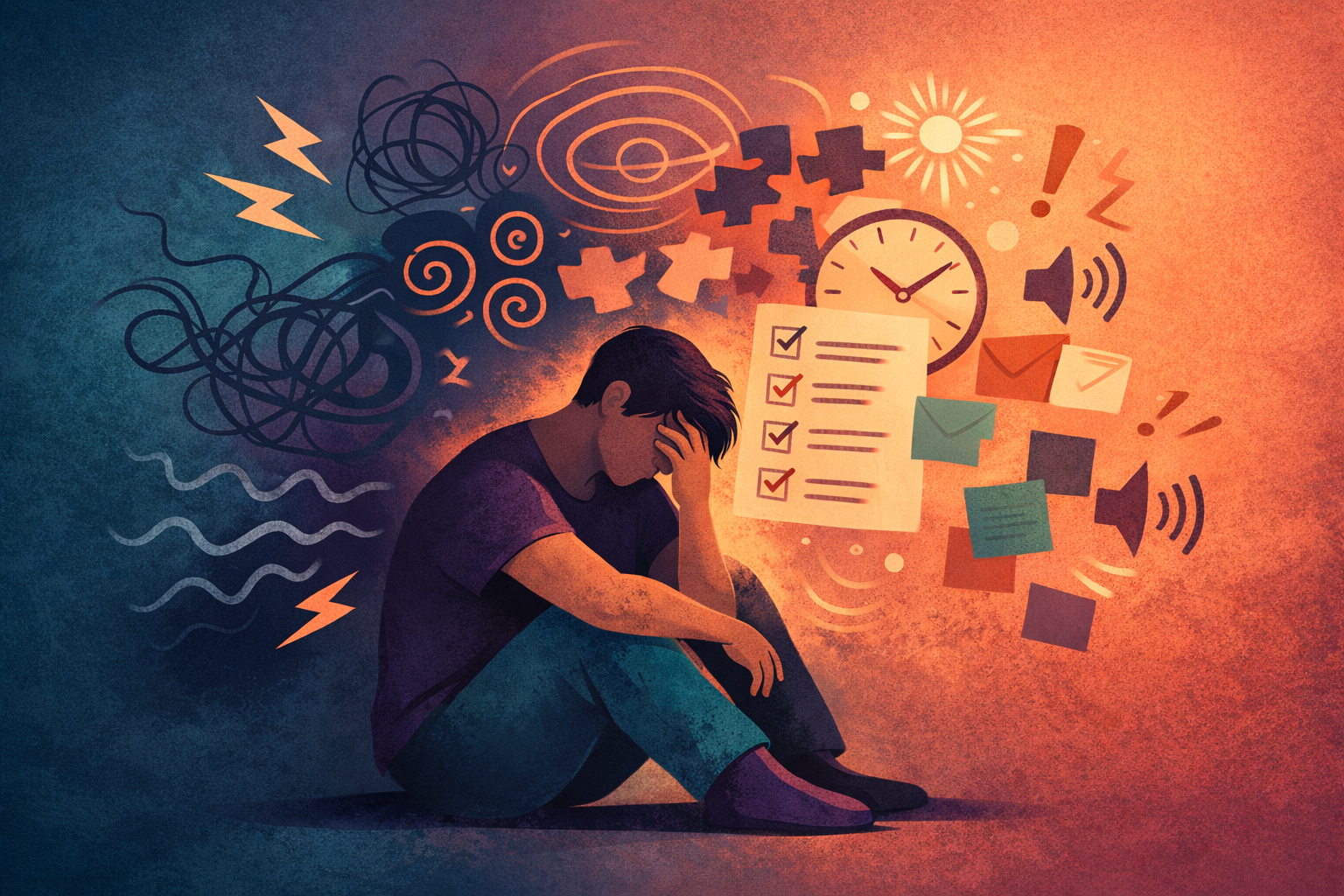
They cannot focus.
They cannot start tasks they once handled easily.
Noise feels unbearable.
Emails feel like threat.
Small decisions feel enormous.
They often say, quietly, “I don’t know what’s wrong with me.”
Nothing is wrong with them.
Something is overloaded.
What I see in the room
I often notice burnout before my clients name it.
Their speech slows. Or speeds up.
Their shoulders sit high and tense.
They apologise for “being useless.”
They describe lying awake at 3am replaying conversations.
When we slow things down in session, there is usually a moment where they realise how long they have been bracing.
The body tells the truth before the story does.
One client, a senior professional in his forties, came to me saying he had “lost his edge.” He had always been the reliable one. The fast thinker. The person who could juggle complexity.
Now he couldn’t read a full page without drifting. He was snapping at his partner and he dreaded meetings.
At one point he said, “I used to be sharp. Now I feel stupid.”
As we mapped his week together, it became clear he was managing sensory overwhelm, masking social discomfort, compensating for executive function strain and working long hours driven by adrenaline. His cortisol levels must have been through the roof!
He had not become less intelligent.
He had become exhausted.
ADHD and the burnout cycle
Adults with ADHD often live in cycles of intensity.
Hyperfocus carries them through deadlines. Dopamine spikes create bursts of brilliance. They may outperform colleagues in short sprints.
But chronic stress disrupts already fragile regulatory systems.
When dopamine drops and cortisol stays elevated, initiation becomes harder. Working memory falters and emotional tolerance narrows.
Clients tell me:
“I know what to do. I just can’t start.”
“My brain feels like fluff.”
“I’m exhausted but wired.” “I NEED SPACE!”
The shame can be immense. Because externally, they still look capable.
What we often do in therapy, is gently separate identity from productivity. We look at the nervous system rather than moral character. We map where overload happens. We reduce cognitive clutter and we begin to rebuild trust in pacing.
Burnout is not laziness. It is depletion.
Autistic burnout and masking
Autistic burnout has a slightly different texture.
It often follows prolonged masking.
Masking can include:
Forcing eye contact
Monitoring facial expression
Managing tone carefully
Suppressing sensory discomfort
Translating social cues in real time
Constant self-editing
That level of social calculation is energy intensive.
When burnout hits, clients describe it as loss of capacity.
“I can’t do people anymore.”
“Everything is too loud.”
“I’ve lost words.”
“I used to cope with this. Now I can’t.”
Some experience shutdown. Others become more reactive. Many withdraw.
In the room, I often notice flatness or tears that come quickly and surprise them. When we slow down and bring attention to the body, there is often compounded fatigue underneath years of effort.
Naming masking can be powerful. The moment someone realises they have been performing rather than simply being, something shifts.
There is relief.
And sometimes grief.
My own experience of burning out
A few years ago, I was working two jobs.
I told myself I could manage it. I am motivated. I can hyperfocus. I can hold complexity.
Gradually, I couldn’t concentrate properly. I would read and not take information in. My memory went unreliable. I became irritable in a way that did not feel like me.
All I could do was the job immediately in front of me. There was no spaciousness left. No creativity. Mistakes happened and exhaustion set in.
Looking back, I can see I had been overriding internal signals for too long. I had normalised high activation.
Burnout forced me to recalibrate.
That experience informs how I sit with clients now. I recognise the particular blend of competence and collapse.
The invisible effort
Neurodivergent burnout is rarely about one bad month.
It is cumulative.
Years of:
Working twice as hard to stay organised
Overpreparing to avoid mistakes
Hypervigilance in meetings
Sensory suppression
Emotional self-monitoring
Adrenaline-fuelled productivity
Many of my clients have built identities around being dependable. High functioning. Low maintenance.
When burnout hits, it feels like identity failure.
Part of the therapeutic work is helping them see that what looked like resilience, was often sustained self-override.
What recovery looks like
Recovery is not about pushing harder.
It often involves:
Reducing cognitive and sensory load
Introducing nervous system regulation practices
Building clearer external structures
Reviewing medication where appropriate
Creating permission to unmask safely
Reworking expectations around output
Being with people who accept you the way you are
In session, we might literally map the week and notice where energy drops. We might practise slowing breath and noticing muscle tension. We might explore the internal voice that equates rest with weakness. Which part is that speaking?
Rebuilding internal trust is central.
Instead of ignoring fatigue signals, we learn to respect them. Instead of measuring worth by productivity, we expand identity.
This is not about lowering standards. It is about sustainability.
A different narrative
Neurodivergent burnout is not a sign that you cannot cope.
It is often the predictable outcome of sustained adaptation in environments that were never designed with your nervous system in mind.
Many of the adults I work with are exceptionally capable.
They are also exceptionally tired.
When burnout is understood rather than judged, something changes.
Shoulders soften, shame reduces and space returns.
And from that space, we can build something steadier. Not driven by constant adrenaline. Not fuelled by self-criticism.
Just human. Sustainable. And real.
